Why One Hurtful Moment Can Sometimes Feel Bigger Than Years of Love, Care and Support
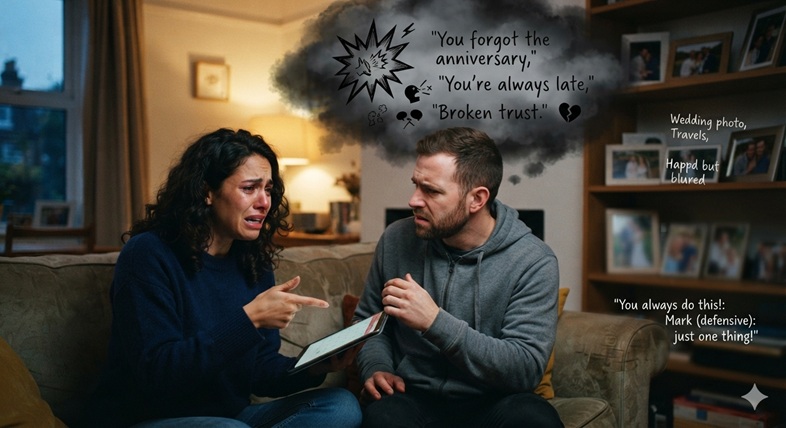
Have you ever had a good relationship with someone for years, only to find yourself unable to stop thinking about one thing they said?
Maybe your partner made a hurtful comment during an argument. A close friend forgot something that mattered to you. Your sibling spoke harshly when you were already having a difficult day.
The conversation may have lasted ten minutes. But somehow, those ten minutes keep returning to your mind. You remember the exact words. You remember their tone. You think about what you should have said. And for a while, all the good things that person has done seem to fade into the background.
There is a psychological reason this can happen. It is partly linked to the negativity bias — our tendency to notice, remember and react more strongly to negative experiences than to equally positive ones. In relationships, this natural tendency can quietly influence how we see the people closest to us.
Why Does One Bad Moment Feel So Important?
Think about the last genuine compliment someone gave you. You probably appreciated it and moved on.
Now think about the last criticism that really hurt. You may still remember exactly what was said. Our brains are naturally alert to information that could signal a problem. Negative experiences often demand more attention because, from a survival perspective, noticing potential threats was important.
Today, the threat may not be physical. It could be a cold reply, an unexpected criticism or a message that suddenly feels different from usual. The brain can still treat that negative information as something worth investigating. That is why one unpleasant interaction can occupy more mental space than several ordinary, happy ones.
When One Incident Becomes “You Always Do This”
This is where a small disagreement can become a much bigger conflict. Your husband forgets to do something you asked. Suddenly, the argument becomes, “You never listen to me.”
Your wife says something dismissive. You think, “I am always taken for granted.” A friend cancels plans. Your mind starts collecting every previous cancellation as evidence that the friendship is one-sided.
The original complaint may be completely valid. But once “always” and “never” enter the conversation, you are no longer discussing just what happened today. You are bringing the entire history of the relationship into one argument. And when we are hurt, our minds can become very good at finding memories that support what we are currently feeling.
Family Conflicts Can Carry Years of Emotional Memory
This becomes especially complicated in families because there is so much history involved. A mother may remember every time her son ignored her advice. The son may remember every time he felt criticised. A brother may focus on one disagreement over money or property, while forgetting the years they supported each other.
Neither person necessarily wants to erase the good memories. They are simply seeing the relationship through the emotion of the moment. This is one reason family disagreements can continue long after the original issue has been settled.
Social Media Gives Us an Unrealistic Relationship Mirror
There is another modern complication. Open Instagram or Facebook and you will see anniversary photographs, birthday surprises, family holidays and friends celebrating together.
What you usually don't see is what happened before or after the photograph. You don't see the argument in the car, the disagreement over household responsibilities or the silent dinner after a misunderstanding.
Real relationships are much less polished. People get tired. They misunderstand each other. They forget things. They say the wrong thing. A disagreement by itself does not tell you everything about a relationship.
Two People Can Remember the Same Argument Differently
Ask two people about an old argument and you may hear two completely different versions. One remembers the sentence that caused the hurt. The other remembers what happened just before it. One remembers feeling attacked. The other remembers feeling ignored.
This is an important part of relationship psychology. Our emotions influence what we notice and what becomes particularly memorable. That does not automatically mean someone is lying or deliberately changing the past.
Instead of spending hours trying to prove who remembers every detail correctly, it can sometimes be more productive to ask:
“What actually hurt us here, and what can we do differently next time?”
That shifts the conversation from winning to understanding.
Repair Matters More Than Perfection
Healthy relationships are not relationships without conflict. They are relationships where people can find their way back after conflict.
A sincere apology, an honest explanation or simply saying, “I shouldn't have spoken to you like that,” can stop a painful incident from becoming the definition of the relationship. Repair does not mean pretending nothing happened. It means acknowledging what happened without allowing it to erase everything that came before it.
Don't Let the Negative Erase the Good
Understanding negativity bias does not mean ignoring genuine problems. If someone repeatedly disrespects, manipulates or hurts you, that deserves attention. Remembering the good does not mean accepting unhealthy behaviour.
But when the issue is an ordinary disagreement, it helps to look at the relationship as a whole. Think about the friend who calls when you are struggling. The partner who quietly takes care of things when you are exhausted. The sibling who stood beside you during a difficult period. These things rarely create dramatic memories. But they matter. Relationships are built through hundreds of small acts of care that can become so familiar that we stop noticing them.
Give the Good Moments Some Attention Too
Positive experiences often pass quietly.
Someone makes you tea without asking. Your partner checks whether you reached home safely. Your friend remembers something you mentioned weeks ago. Your sister calls simply because she was thinking about you. These moments may not keep you awake at night.
But they deserve to be noticed. In fact, consciously recognising positive experiences can help create a more balanced view of a relationship. It does not cancel the negative; it prevents the negative from becoming the only thing you can see.
Look at the Whole Story
The next time someone you love disappoints you, it is okay to be hurt. You do not have to pretend that the moment did not matter.
But before allowing one incident to change how you see the entire relationship, pause and ask yourself: “Am I looking at this relationship as a whole, or only through its most painful moment?” That pause can create perspective.
Because relationships are made up of thousands of ordinary moments — conversations, misunderstandings, laughter, arguments, forgiveness, support and second chances.
One bad moment can be loud. But it does not have to become the whole story.